 {A Claude Glass, or Black Mirror}
My love for antique optical devices started with my discovery of the Stanhope, and it has snow-balled into a mini obsession. The Victorians certainly found clever ways to fulfill their need for visual stimulation with a plethora of odd optical toys and fascinating illusionary devices. The names of the devices alone are enough to make me giddy with intrigue. For example, doesn't the Black Mirror sound like something straight from Grimm's Fairy Tales? Despite its sinister-sounding nickname, the Black Mirror {also called a Claude Glass} was a small pocket-sized mirror used by landscape artists in the 1700's and 1800's. The slightly convex mirror had a dark surface, and when held up, it would abstract the scenery reflected in the surroundings. The image would have a soft, slightly painterly quality, which the painter could then use as inspiration for his work.

:The Camera Obscura {aside from being the name of one of my favorite bands} is an optical device that projects the image of its surroundings onto a screen using a hole. The earliest know account of a camera obscura being used was from 5th century BC. They became popular devices during the 19th century when they were installed at tourist destinations and seaside resorts -- a precursor to movie theaters!

:Like the Black Mirror, the Camera Lucida was used as a drawing aid by artists. It creates an optical superimposed image of the subject being viewed on the surface the artist draws upon. A bit like cheating, no?

:The Magic Lantern was a very popular form of entertainment in the Victorian period. Magic lantern shows were the combination of projected images, live narration, and live music. Some lanterns had up to three lenses, which allowed for the creation of various special effects. I'm certain I would be totally mesmerized by this even today!

:The Phantasmagoria was probably as terrifying as it sounds...particularly to unsuspecting old ladies! This was also called "Pepper's Ghost Effect" and it was often used in theater productions during the 1800's. Victorians were notoriously obsessed with death and the supernatural, so clever theater managers began using a modified magic lantern to incorporate images of ghosts and skeletons into their productions. The projectors were mobile, so the operator could create the illusion that the ghost was moving around the stage.

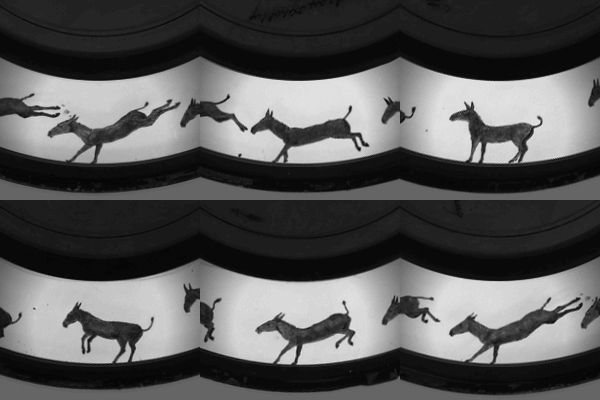
:The Zoopraxiscope was an invention by the photographic genius Eadward Muybridge. The zoopraxiscope projected images from rotating glass disks in rapid succession to give the impression of motion -- an early precursor to film!
::If you find these objects as fascinating as I do, you really must treat yourself to a visit to The Richard Balzer Collection to see an amazing collection of optical devices in action / And how about this fascinating tidbit: In 2001, artist David Hockney's book Secret Knowledge: Rediscovering the Lost Techniques of the Old Masters argued that great artists of the past, such as Ingres, Van Eyck, and Caravaggio did not work freehand, but were guided by optical devices {via}. Shocking!


 Posts
Posts


